Ak-Chin is still a growing community. The population is relatively small at a little more than 120 O’odham residing in the main village.
The U.S. Government encourages the Ak-Chin O’odham to adopt family farm land allotments thus disrupting traditional farming practices.
On May 28, 1912, President Taft, by Executive Order created a 47,600 acre Ak-Chin Indian Reservation. One week later United States filed notices of appropriation of waters to Ak-Chin in the amount of 10,000 acre-feet into the Vekol wash and 60,000 acre-feet in to the Santa Cruz River annually.
Within the same year, a second Executive Order by President Taft issued on September 2, 1912 reduced the size of the reservation to 21,840 acres.
Trends in home architecture shift in Ak-Chin as the traditional olas ki (round house) becomes replaced by square ṣamt ki:kĭ (adobe homes).
The Saint Francis of Assisi Chapel is built in the center of the main Village, serving as a focal point for religious activity in Ak-Chin. The very first day school and classes for Ak-Chin children were held in the chapel for roughly ten years.
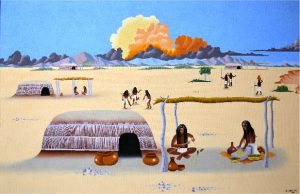
Traditional pottery production fades out as Ak-Chin O’odham import readymade wares from nearby towns. In the 1930’s, only a handful of traditional O’odham potters remain in the Ak-Chin village. The Saint Francis Mission School is constructed and children no longer attended classes in the chapel. Ak-Chin children attended up to the fourth grade and were prohibited from speaking O’odham in school.
The Saint Francis Mission School closes in 1949 after its sole teacher, Isabel Kisto, falls ill and retires back to her home village of Bapchule on the Gila River reservation. No replacement was ever hired.
Ak-Chin children begin to attend public school in the neighboring town of Maricopa. Vehicle transportation was still widely unavailable so children walked to Maricopa to attend school.
Ak-Chin’s first telephone is installed at the Historic BIA House, referred to as Ak-Chin One.
In 1961, the Articles of Association and By-Laws that help govern the Ak-Chin Indian Community were adopted. The first Community Council is voted into office by Ak-Chin members. The Council consisted of 5 seats; the Chairman, Vice-Chairman and three Council Members.
In 1962, the Council officially terminates leasing to non-Native farmers and begins the Ak-Chin Farming Enterprise. The purpose was to allow Ak-Chin control over their own farming profits and to provide jobs for community members.
The U.S. Government fails to meet the stipulations of the 1978 Settlement Agreement. Ak-Chin enters into the Ak-Chin Indian Water Rights Settlement Act of 1984. This act provides a permanent water source to the Ak-Chin people.
This act reverses previous restrictions on water use. Ak-Chin would now receive water to be used at the discretion of the Community.

In 2003, the Council approves funding to design a new facility, the Ak-Chin Ge’Gelik Ha Ki. The facility was built to provide services to Ak-Chin Elders.
In 2008, both the Community Service Center and Early Childhood Pre-School and Day Care Center opened for community use.
In 2009, the Ak-Chin’s Library/Education building opens providing student services, library services and public internet access for Ak-Chin members.
Community members become aware of non-Native farmers profiting from Ak-Chin farmland while Ak-Chin’s people live in relative poverty just a few miles away. The disparity in income between the two groups prompts Ak-Chin members in the late 1950’s to begin plans to terminate the non-Indian farm leasing program initiated by the Bureau of Indian Affairs (BIA) in the 1940’s.
Ak-Chin reaches its first Water Settlement Agreement with the United States, the first settlement of its kind in Indian Country. Water was and is an essential resource to Ak-Chin’s farming heritage.
The United States Government agrees to protect the water rights and resources of the Ak-Chin O’odham which had been systematically diverted from Ak-Chin to serve the surrounding areas.
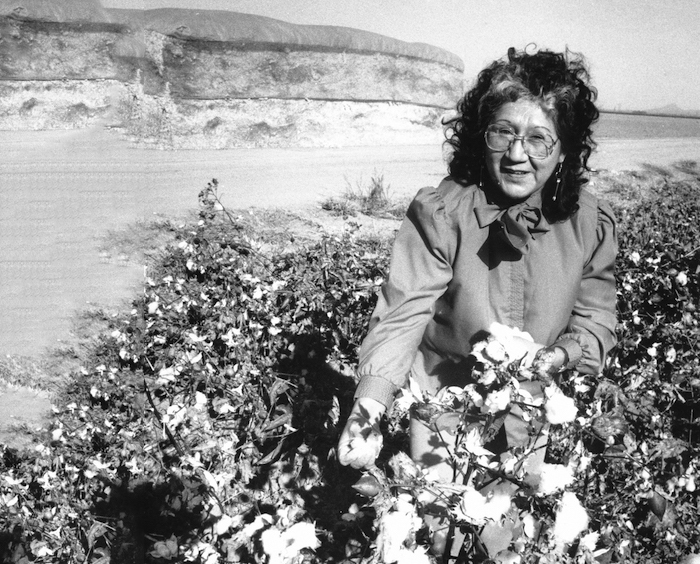
The Ak-Chin Him-Dak Eco-Museum opens in 1991 with the goal of preserving the local culture, traditions, history, cultural objects and language of the Ak-Chin Community. This is the first and to date the only Eco-Museum in the United States.
Harrah’s Ak-Chin Casino opens its doors in 1994, providing a new source of tribal revenue and increased job market for Ak-Chin Members.
In November of 2016, Ak-Chin members went to the polls to elect Council members under the new Ak-Chin constitution and for the first time elected all seats of tribal leadership.
In 2012, Ak-Chin constructs the first entertainment facility in the area, UltraStar Multi-Tainment Center-unlike any other entertainment facility in both the state and country.
In July 2016, Ak-Chin members adopt a new constitution passing by nearly 90% of votes casted.
In November of 2016, Ak-Chin members went to the polls to elect Council members under the new Ak-Chin constitution and for the first time elected all seats of tribal leadership.